Ayurvedic Samosas and Rolls - Recipe for a healthy Alternative without deep-frying
Suitable Body Types
Cooking Times
Preparation Time: 30 minutes
Cooking Time: 20 minutes
Total Time: 50 minutes
Categories
Ingredients
For the filling:
100 g Potatoes
100 g Cabbage
100 g Carrots
50 g Green Peas
100 g Paneer
a bunch fresh Coriander Leaves
a small piece fresh Ginger
½ tsp Cumin Seeds
½ tsp Garam Masala
Salt according to taste
For the dough:
5 tbsp Wholemeal Wheat Flour
1 tbsp Semolina
1 tbsp fine white Wheat Flour
1 tsp Oil
1 tsp Salt
1 tsp Cumin Seeds
1 tsp Carom Seeds
1/2 cup Yoghurt
Nutritional Value
- Calories: 405 kcal
- Protein: 23g
- Carbohydrates: 49g
- Fat: 14g
- Fiber: 8g
Instructions
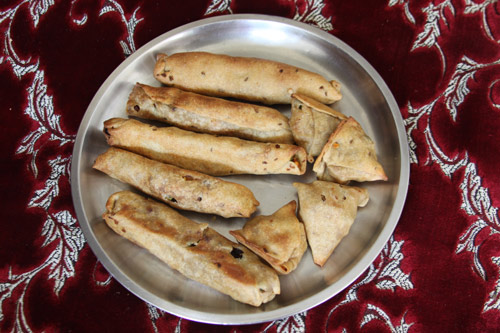
Ayurvedic Samosas and Rolls - A healthy, low-fat Alternative
Prepare delicious samosas without deep-frying and thus keeping them light and healthy!
How to make Ayurvedic Samosas
As usual, the very first step is to wash your vegetables really well before you start preparing them.
In winter we usually have a fire burning and can roast the potatoes easily on the flames. If you have such a possibility, you can start by roasting the potatoes and then peeling them once they are soft inside. If not, just boil them in water until they are soft and then peel them. In any case, after you have peeled them, you break and mash them separately in a bowl.
While the potatoes are boiling you can cut the cabbage in very fine pieces, taking out the stump. Cut off the ends of the carrots on both sides and then either cut them in very fine pieces or grind them with a grater. If you have fresh green peas, you need to peel the single peas out of their hulls. Peel the ginger and cut it very finely. Pick the coriander leaves and tear or cut them into small pieces as well.
We can buy ready-made paneer here and you could easily substitute that with tofu if you like. Alternatively you can also make the paneer yourself with this recipe. You need pieces which are just as fine as the ones you made from the carrots. Finally you can mix all the vegetables and the paneer together. It doesn’t matter if there are still pieces of the potatoes or the paneer visible.
Heat up half a tablespoon of oil in a pan and when it is hot, add the cumin and the garam masala while you keep on stirring. When the spices have developed their aroma, add the filling paste into the pan and stir it well for two minutes until the spices are well mixed into it and it has become slightly golden. Put it aside in a bowl.
Mix the wholemeal wheat flour with the semolina, the white wheat flour, the cumin, the carom seeds, one teaspoon of salt and one teaspoon of oil together. Mix it well and then add the yoghurt. Make a nice dough out of it which you then knead thoroughly. It should not be sticky and when you poke your finger into it, the dough should soon fill the gap that you made.
After all this mixing and kneading, you get to tear pieces off the dough in order to make small balls which are bigger than cherries but smaller than table tennis balls. Place one of these balls on a floured surface and roll it out thinly. Now you can decide if you want to make rolls or samosas.
In order to make rolls, you spread one tablespoon of the filling vegetables on the circle and then start rolling it up from one side. If the dough sticks to your fingers, put a tiny bit of oil onto them – then it won’t be sticky anymore. When it is rolled up, just fold the sides towards the middle and press them together so that they are closed. If they don’t stay closed, simply makes a finger wet with water and slide it across the place that should stick, press once more and it will remain as it should.
If you want to make Samosas, cut the round circle of dough into two halves. Place a table spoon of filling in the center of one of these halves and the take the two ends. Move them towards each other and form a cone. The dough has to overlap and you press a little bit on that overlapping area so that it will stick together nicely. Now you just need to close the opening of the cone by pressing it from two sides together. Again, should something not stick well, just put some water on that area and press – it will stick!
Now they are ready to be placed into the oven, as this is a healthy version of samosas or rolls without deep-frying anything. You need to bake them at 200 degrees for about twenty minutes. During this time you need to turn them from time to time so that they can evenly baked from all sides. They are ready when they are golden and crispy.
Take them out and serve them with chutney, pesto or any similar dip or sauce!
Ayurvedic Benefits
Suitable Body Types
For the filling:
100 g Potatoes
100 g Cabbage
100 g Carrots
50 g Green Peas
100 g Paneer
a bunch fresh Coriander Leaves
a small piece fresh Ginger
½ tsp Cumin Seeds
½ tsp Garam Masala
Salt according to taste
For the dough:
5 tbsp Wholemeal Wheat Flour
1 tbsp Semolina
1 tbsp fine white Wheat Flour
1 tsp Oil
1 tsp Salt
1 tsp Cumin Seeds
1 tsp Carom Seeds
1/2 cup Yoghurt